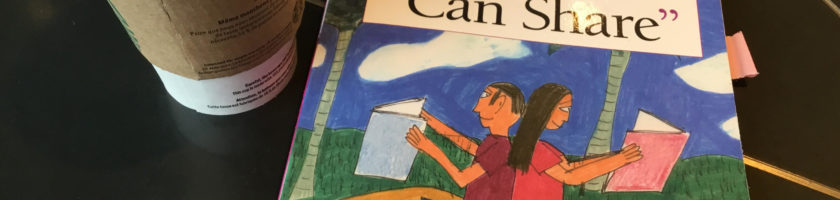
Book Review: A Land We Can Share
Communication and literacy are important goals for improving quality of life for autistic children. However, parents and teachers may need more strategies for supporting these goals. A Land We Can Share: Teaching Literacy to Students with Autism by Paula Kluth and Kelly Chandler-Olcott is an excellent and practical resource for helping kids on the autism spectrum read and communicate.
The Experiences of Learners
The authors of this book began by describing what they have learned from the experiences of autistic literacy learners. To prepare for writing, they reviewed 16 book-length autobiographies to ask the following questions:
- What do people with autism who write autobiographies report about their development of literacy?
- In the view of autistic individuals, what aspects of their homes and school communities supported them in developing literacy?
- What instructional practices for supporting students’ literacy development might be suggested by the accounts of these people? (p. xxiii)
As a result, the book contains a unique combination of reflections by people with autism along with strategies to support learning in inclusive classrooms.
Defining Literacy
Before we can teach literacy, we need to know what it is. Chapter 2 explores what literacy means.
First, the author discusses the concept of presuming competence. This means that we understand that autistic people think and feel just like the rest of us. The barrier is different styles of communication. When a student does not show us what they know or can do, the teacher’s response should be to think about what other approaches could be tried to support connection, communication and learning (p. 33). We assume that a person always has reasons for their actions, and that they have the potential to learn and to grow.
Next, the idea of multiple literacies values a wide range of literacy skills, which students may not be able to show us in ways that are easy to measure.
“Students demonstrate literacy when they act out a scene from a favorite movie, page through a book, have a conversation, listen to the teacher read a poem, illustrate an idea, tell a joke, or show a peer how to use their communication board or sign system.”
If a child is receiving or sharing information or ideas, they are practicing literacy.
All literacies are valuable.
All literacies happen within a social context (because literacy is about communication).
All literacies serve a social purpose.
Literacy, then, happens when people explore ideas with other people.
Autism Means Differences, Not Problems
In the book, autism is viewed through the social model of disability:
“…we recognize that some people have severe struggles, challenges and impairments due to their disability, but we also understand that those same individuals may be more or less disabled by the barriers that exist in a society that does not take account of their needs and differences…some individuals with autism indicate that the most disabling aspects of their lives are the attitudes, perspectives, and actions of those without labels.” (p. 4)
In chapter 3, autism is described as differences in:
- movement
- sensory experiences
- communication
- social behaviour
- learning
For each, implications for literacy are also explored.
This list of characteristics of autism is a useful, non-judgemental way to frame discussions with children’s classmates, and to help them understand that they have a lot in common with their autistic peers.
Inclusive Literacy
Since literacy is a social activity for social purposes, it is the foundation of inclusive classrooms. Children with autism benefit from good teaching strategies and affirming and welcoming relationships as other children do. All children benefit by observing how others learn.
Chapter 3 explores seven principles for promoting inclusive literacy, which are:
- maintaining high expectations
- providing models of literate behavior
- eliciting students’ perspectives
- promoting diversity as a positive resource
- adopting “elastic” instructional approaches
- using flexible grouping strategies
- differentiating instruction
Also, chapter 7 focuses on literacy learning for students with more significant barriers to communication.
Literacy is for everyone, and the authors make that very clear.
Assessments
Accurately assessing the knowledge and skills of students with autism can be difficult. While we might know some of a student’s capabilities, we don’t always know everything they know and can do.
Formal assessments can be problematic. Tests are designed to be given to children who know how to write them, and are either compliant or willing to do their best. This may not apply to children or teens with autism, but that doesn’t mean they are not capable or knowledgeable.
It’s important to assess authentically by observing what a student does and shares in his or her daily activities. The book features some useful suggestions about accommodations and interpretation of the results when formal testing is necessary, and about “out of the box” ways to assess learning.
Ideas for Teaching and Learning
Chapter 5 and 6 focus on reading, writing, and representation.
Each chapter breaks learning down into:
- phonics
- fluency
- comprehension
- vocabulary
- writing fluency
- planning and organizing
- revising and editing
Each section has considerations about students with autism to keep in mind, and many suggestions for instruction.
Designing Education to Fit Each Child
Every person has strengths and challenges in learning. Everyone benefits from approaching learning in multiple ways, and from having the freedom to express what they’ve learned in ways that fit their strengths.
The perspectives and teaching ideas in this book are helpful for all learners, because by considering the needs and interests of all the members of a class, we give all children an opportunity to thrive. If you are a teacher, you should read this book. If you aren’t, you might want to give it to your child’s teacher.
“Given that we seek the small and manageable, it is no surprise that high-functioning autistic people, unable to communicate with others above the ringing swirl, shout across the canyons of reality by writing…There we find a peaceful world of art and order, a land we can share. Thus, writing was my salvation. I have said in the past, and I have since heard it repeated by other autistic people, that written English is my first language and spoken English is my second. Since I was five years old, I have written all the wonderful and terrible things that I could not bear to share.”
Songs of the Gorilla: My Journey Through Autism by Dawn Prince-Hughes, p. 25-26 (2004).
Hi Deborah ,
Thank your. I love your review but i didnt know from where to buy the book . Luckely i found it on http://justreadbook.com (I don’t know if i can leave a link ) but i think it will help others too. I like the book ” A Land We Can Share” and also i recommend others to read it.
Thanks, Vincent.
Glad you liked it! Thanks for letting us know. The book is also available on Amazon.