Understanding DIR/Floortime
Every child grows.
Every child is unique.
Every child thrives when an adult loves and interacts with them.
These are the principles that guide DIR/Floortime.
DIR/Floortime is an approach to helping parents support the learning of children with autism. It’s based on the idea that even when children seem to be delayed in social and emotional development compared with other children, they continue to grow as all children do – especially with purposeful support. Social and emotional development are foundational to all areas of learning, and so as the child progresses in emotional regulation, communication and the ability to connect socially, they are able to learn in other ways as well.
The ideas behind DIR/Floortime were assembled by Stanley Greenspan and Serena Wieder; however, not all of the ideas are unique to them and in fact, most are found in common understandings about early childhood development. The Hanen Program and Relationship Development Intervention (RDI) are other programs that share many of these ideas. Research on best inclusive educational practices also echo many of the ideas in DIR/Floortime.
What Does DIR Stand For?
D – Developmental – The child is growing and learning. Autistic children grow and develop just like other children, but may face other co-occurring diagnoses that impact their developmental process such as dyspraxia, sensory processing challenges, and many more (intellectual disability, OCD, ADD, ADHD, etc.). With support that respects their needs and preferences, they can progress more quickly towards independence, competence and connection.
I – Individual Differences – Each child (whether autistic or not) has unique strengths, challenges, communication styles, and interests. Attention must be given to discover these characteristics to adjust the child’s environment and learning opportunities.
R– Relationship-Based – All children develop and learn through warm and loving relationships with parents and other trusted adults. Learning activities build on and deepen relationships.
DIR/Floortime describes overlapping stages of social development. It offers an approach that helps parents invite their children into playful interactions using imagination and problem solving to build communication and thinking skills.
The described stages (or developmental tasks) are:
- Self-Regulation and Interest in the World
- Engaging and Relating
- Intentionality and Two-Way Communication
- Complex Communication and Shared Problem Solving
- Using Symbols and Creating Emotional Ideas
- Logical Thinking and Building Bridges Between Ideas
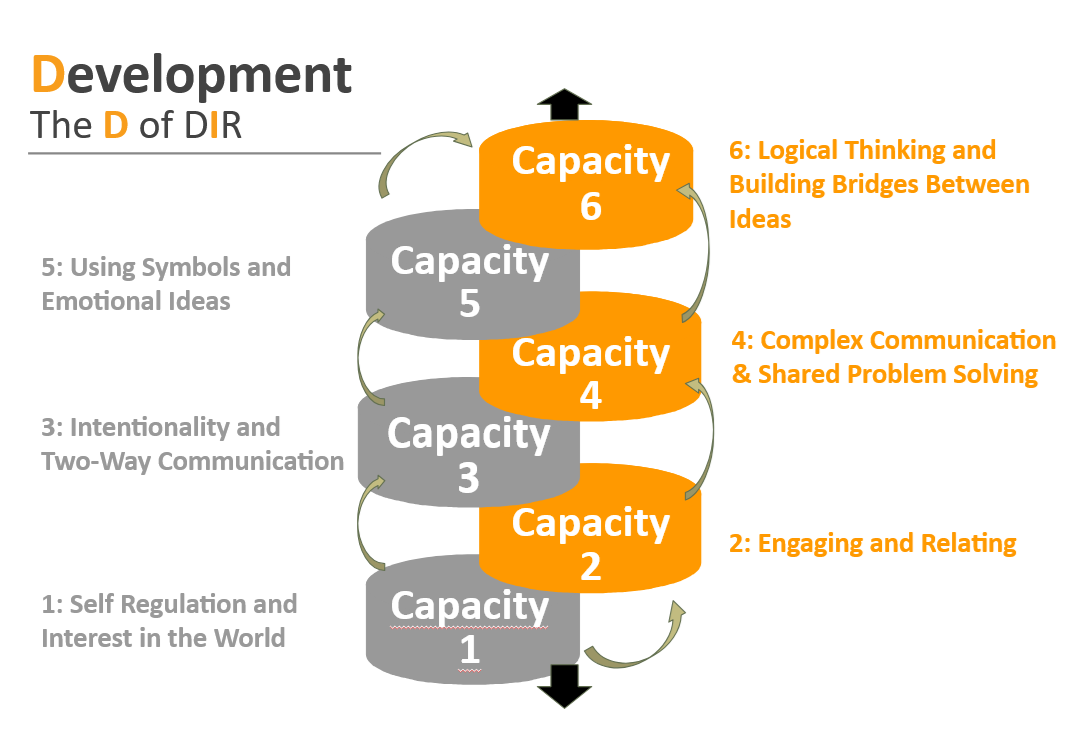
Each level builds on and works with the previous levels. These capacities develop as a spiral; children can’t build more complex abilities without continued attention to all the foundational skills that come before.
What About Floortime?
Floortime describes the set of techniques to invite children to play with a trusted adult, especially important in early childhood. It is a misconception that doing DIR/Floortime means that the child is in control of all activities. Rather, caregivers use the child’s interests as a starting point to build relationships, social skills and understanding. As the child progresses, he or she is challenged to also follow the lead of others and enter a back-and-forth exchange of ideas and collaborative activities.
Want to know more? You can visit the ICDL webpage for information and links to resources. You can also find a DIR Parent Support Network, which offers opportunities to connect with other parents and a variety of family-centred resources. The Provider Directory can help you find a DIR/Floortime certified therapist in your area, or who can work with you virtually.
The links below connect to a series of articles on this website exploring the capacities described in DIR/Floortime, and how parents can support each of these important areas of growth.
Next post: The “I” in DIR: Knowing Your Kid
Level 1: Self-Regulation and Interest in the World
Level 2: Engaging and Relating
Level 3: Intentionality and Two-Way Communication
Level 4: Complex Communication and Shared Problem Solving
Level 5: Using Symbols and Creating Emotional Ideas
Level 6: Logical Thinking and Building Bridges Between Ideas
Thanks to Daria Brown of Affect Autism for providing input for this article.